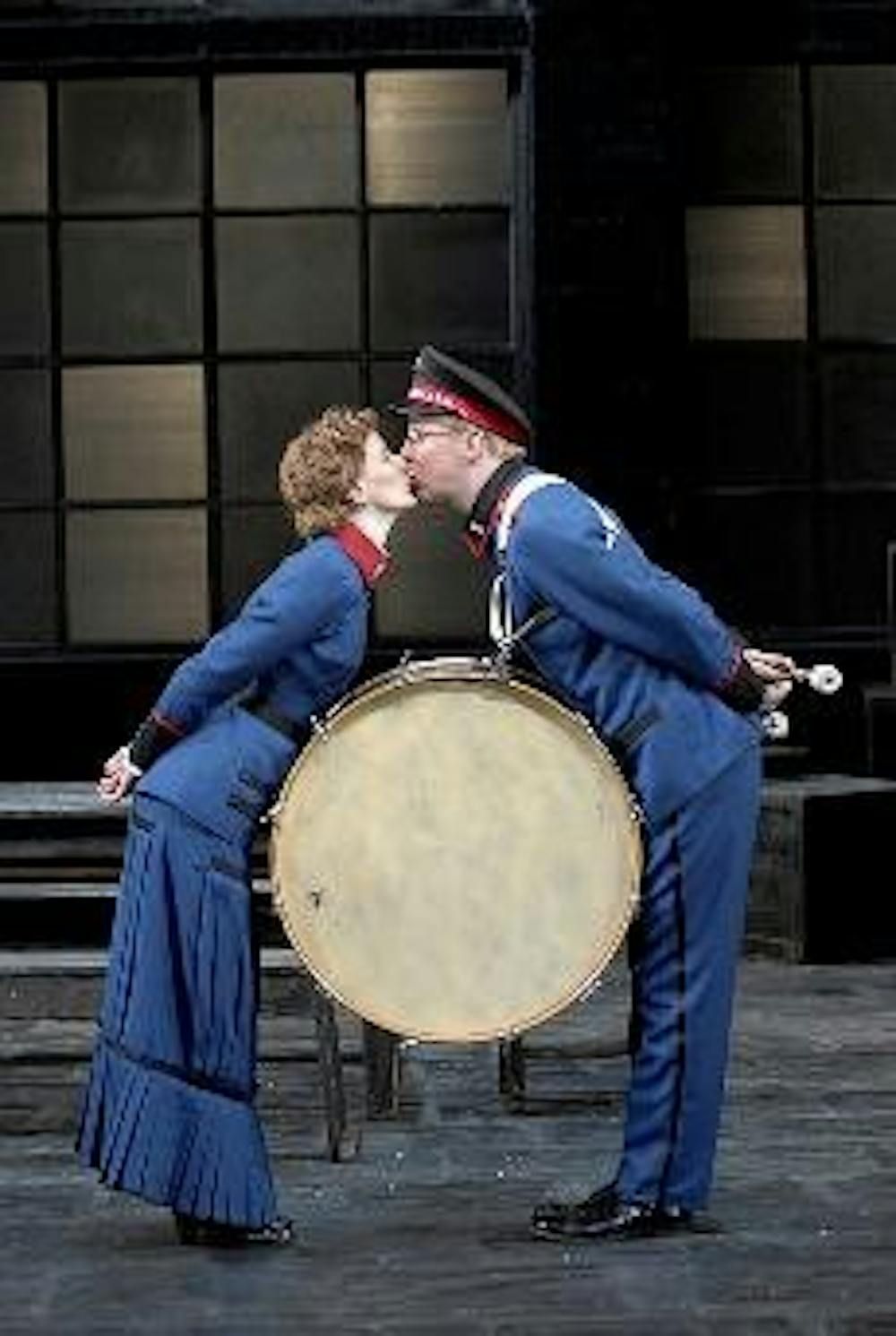
"Major Barbara" by George Bernard Shaw opened Feb. 19 at the Shakespeare Theatre's Harman Arts Center. This production of "Major Barbara" marks only the third time the Shakespeare Theatre has produced a work by Shaw and the first time it's entertained audiences with his work in the new theater.
Shaw, who was called a communist, an atheist and a counter-revolutionary, takes a look at some of the biggest issues facing the world in 1905, when he wrote the play. As a socialist and a lover of Marx, Shaw subscribed to radical ideals, such as war being the only way to end poverty and arms as a means to revolution. In "Major Barbara," Shaw toys with the idea of the desires of the wealthy few triumphing over the interests of the majority and the role of religion.
The title character, Barbara Undershaft, played by Vivienne Benesch, is the daughter of an elite British family. Her sister Sarah (Leah Curney), brother Stephen (Tom Story) and mother Lady Britomart (Helen Carey) are all estranged from their millionaire of father, Andrew Undershaft, played by Ted van Griethuysen. Barbara, who has renounced her family's wealth and joined the Salvation Army with her fiancé, Adolphus Cusins (Karl Kenzler), finds her father's profession of making cannons and artillery distasteful. Andrew Undershaft finds Barbara's search for souls cheap, arguing anyone will believe anything to avoid starvation. The conflict of the play rests in this struggle between two oppositely convicted, determined characters.
The Shakespeare Theatre, never in want of money, dressed the production of "Major Barbara" in the best wrappings it could find and paid specific attention to minute details in both set and costume. For the most part, the sets, designed by James Noone, show lavish care. The Undershaft home is a Victorian mansion complete with oversized globe and marble floors. Rich draperies frame the windows and bookshelves tower over the actors. The Salvation Army set is a scene out of Charles Dickens' world, perfectly distressed with worn walls and a rough stone floor. The Shakespeare Theatre utilizes its multi-story space, having a character pop out of an upper window once or twice, adding to the feel of a true London slum street. Costume designer Robert Perdziola played with fabric color and texture to draw lines between Barbara and the rest of her family.
The last set, however, fails to live up to the previous standard. The Undershaft Factory looked far from the beautiful, graceful utopia it was described to be. One is more likely to think of Willy Wonka's factory, complete with the little workers in their white jumpsuits, pushing around dummies and torpedoes when watching Barbara whirl around in a state of awe and confusion. The white buildings topped with bright red roofs create a sterile, controlled environment, but lack any warmth or grace. As the final set of the play, it feels awkward that this is the image with which the audience left.
The actors, some company members and others new to the Shakespeare Theatre, each effectively identified their role and did their best to display those qualities. This sometimes worked to the detriment of the overall effect, though. Story came off as a whiney momma's boy who had no backbone, no heart and no personality. Andrew Long, who played a visitor to the Salvation Army, had urgency to his character, but his thick Cockney accent made it almost impossible to understand his lines.
Carey, who played Lady Brit, and van Griethuysen, as Andrew Undershaft, took their roles in stride and presented three-dimensional people. At times it was hard to like the religiously fevered Benesch as Barbara, but she mostly succeeded in taking the audience along Barbara's journey from proud to forsaken to triumphant again.
Lasting two hours and 45 minutes, Shaw's text can get the better of lesser actors and an uninterested audience, but the Shakespeare Theatre's company does an admirable job of keeping the energy of the show high. A solid performance with themes such as war and poverty ripe for discussion in today's society, "Major Barbara" will appeal to both seasoned theatre critics and newcomers alike.